
Author Archives: dyadmin

Why Cheap Mining Equipment Costs You More in High-Yield Gold Mines

Maximizing ROI through High-Throughput and Heavy-Duty Engineering

In the alluvial gold mining industry, especially in highly productive regions with exceptional gold grades, mine owners face a critical decision during the initial investment phase. The temptation to opt for low-priced, low-end equipment manufactured by small workshops in neighboring regions is highly prevalent.

On the surface, low-cost machinery minimizes your upfront capital expenditure. In reality, however, the moment the operation begins, inefficient equipment starts draining your potential profits. For a high-yield gold mine, deciding based solely on the initial purchase price rather than production capacity and operational reliability can lead to severe financial losses. Below is a technical breakdown of why a heavy-duty Vibrating Screen and Pulsating Sluice Box System is the only viable solution to maximize your profitability.

1. The Hidden Traps of Low-Cost Machinery

Opting for cheap, sub-standard mining equipment introduces several structural bottlenecks that directly damage your bottom line:

  • Severely Limited Production Capacity: Cheap equipment is structurally incapable of handling large volumes. While your mine contains massive rich deposits, low-end machinery operates at a fraction of the required speed, severely choking your daily output.
  • Frequent Mechanical Failures: Built with thin steel plates and underpowered or refurbished motors, these machines break down constantly under high-load conditions. In mining operations, every single day of downtime translates directly to thousands of dollars in lost pure revenue.
  • High Tailings Losses (The Fatal Flaw): Low-end pulsating sluices suffer from rapid bed compaction. When the sand bed hardens, fine and flaky gold cannot settle and is washed straight into the tailings. In a high-grade mine, a low recovery rate means you are discarding pure gold as waste daily.

2. Dayang Gold Recovery Systems: 5 Core Engineering Advantages

Professional mining machinery is engineered not merely to save costs, but to actively maximize production and revenue. Dayang‘s integrated vibrating screen and pulsating sluice box systems deliver five uncompromising technical advantages:

A. Superior High-Throughput Capacity

In high-yield mining, volume dictates profit. Dayang equipment is heavy-engineered and optimized for maximum load capacity. Our system processes substantially more raw material per hour than standard low-end alternatives. Operating under identical shifts, Dayang enables you to process multiples of the ore volume, accelerating your capital turnaround.

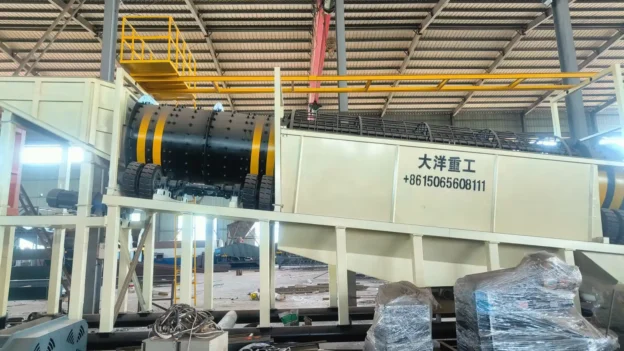
B. Non-Clogging Conical Hole Vibrating Screen

Conventional screen decks suffer from severe aggregate wedging. Once the screen openings are blinded by near-size rocks, screening efficiency plummets, forcing manual stoppages.

  • Dayang’s Engineering Solution: The screen plates are precision-machined with a special conical geometry (narrower at the top, wider at the bottom).
  • Operational Benefit: As soon as an rock particle passes the top aperture, the expanding space below guarantees it drops through instantly without sticking. This ensures continuous, 24/7 high-capacity classification without operational interruptions.


C. Heavy-Duty Power & Transmission Systems

The power unit is the heart of the plant. Low-end machines cut costs using low-grade motors that burn out under fluctuating voltage or continuous load. Dayang configures all units with premium, high-torque industrial power systems. They offer exceptional thermal resistance and fatigue life, ensuring uninterrupted operation in extreme mine environments.

D. Maximum Recovery Architecture

For high-grade gold deposits, we scientifically calibrate the pulsation frequency and rubber bed mechanics of our sluice boxes. The precise vertical movement maintains the bed in a perfectly fluidized, loose state, completely eliminating compaction. This allows the system to trap heavy coarse gold as well as highly elusive fine, microscopic, and flaky gold particles, pushing the recovery rate significantly higher than conventional alternatives.

E. Industrial-Grade Reinforced Steel Plates

Mining machinery must withstand intense abrasive wear and violent impact from heavy gravel. Dayang utilizes ultra-thick, high-density structural steel plates in all critical load-bearing and wear-intensive areas. This heavy-duty construction provides extreme structural rigidity and vibration dampening, extending the lifespan of the machine by multiple years compared to standard market alternatives.

3. The Economics of Capacity and Production

When investing in mining machinery, the true financial calculation must be based on total production volume and throughput efficiency, not just the initial equipment cost. High-throughput machinery changes the entire financial dynamic of a high-yield mine.

Operational Metric Low-End / Low-Cost Equipment Dayang High-Capacity Equipment
Raw Ore Processing Capacity Low / Limited Throughput Ultra-High Throughput
Screening Efficiency Frequent clogging, constant cleaning stops Continuous processing via Conical Holes
Downtime Risk High failure rate due to thin steel & weak power Minimal downtime via Heavy-Duty Engineering
Gold Output per Day Severely limited by low processing volume Maximized through continuous, massive volume

The Reality of the Math:
In a high-grade gold mine, a low-capacity machine limits your daily processing volume, meaning you leave massive amounts of gold unmined in the ground every day. By saving a small amount on the initial purchase price of cheap equipment, you sacrifice huge volumes of daily production. Within just a few days of operation, the value of the unproduced gold far exceeds the entire purchase price difference of the machinery.

4. Conclusion

Mining equipment is the foundational profit engine of your operation. Selecting a low-capacity, low-end machine compromises your entire mining timeline and daily revenue potential. High-grade gold deposits require heavy-duty engineering capable of continuous, massive-scale processing. High-quality construction and advanced technical features like conical screening and reinforced structural steel represent the true baseline for long-term mining profitability.

Comprehensive Guide: What Is Coltan and How to Process It Efficiently?

In the modern industrial and tech-driven world, Coltan has become one of the most strategic mineral resources. As digital transformation accelerates globally, the demand for high-purity tantalum and niobium—both extracted from coltan—is skyrocketing.

If you are looking to maximize the recovery rate of your mining project, understanding the nature of coltan and its beneficiation process is essential.


What Is Coltan and Why Is It Valuable?

Coltan is short for columbite-tantalite. It is a dull black, high-density metallic ore from which the elements niobium (Nb) and tantalum (Ta) are extracted.

These two metals possess unique chemical and physical properties that make them indispensable in modern industry:

  • Tantalum (Ta): The backbone of the electronics industry. Due to its exceptional energy storage capabilities, high strength, and corrosion resistance, it is widely used to manufacture capacitors for smartphones, laptops, automotive electronics, and advanced medical equipment.
  • Niobium (Nb): Crucial for the metallurgical sector. Over 80% of global niobium is used as an alloying element to produce high-strength, low-alloy (HSLA) steel for aerospace, structural engineering, and pipelines.

Because raw coltan ore generally features a low grade and coexists with other heavy minerals (like tin and tungsten), deploying an advanced coltan beneficiation plant is the only way to achieve high-grade concentrates that meet global smelting standards.


Core Methods of Coltan Beneficiation

Processing coltan requires a combination of physical and magnetic techniques due to the high density of tantalum-niobium and their specific magnetic susceptibilities. The standard process involves:

  1. Washing & Desliming: Crucial for alluvial ores with high clay content. It prevents muddy materials from interfering with gravity separation.
  2. Crushing & Grinding: Breaking down large rocks or aggregates into optimal particle sizes to liberate target minerals without over-crushing.
  3. Gravity Separation: Utilizing density differences to separate heavy minerals (coltan, tin) from light waste rock (gangue).
  4. Magnetic Separation: Using high-intensity dry magnetic separators to isolate coltan from tin (cassiterite), iron, and other magnetic impurities.

Two High-Efficiency Coltan Processing Solutions

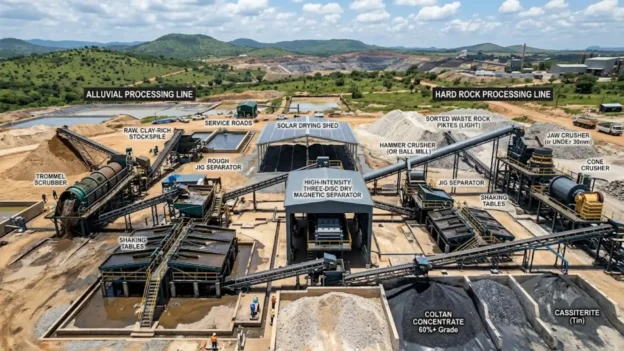
Depending on whether your raw material is loose alluvial deposit or hard rock, the plant configuration varies significantly. Here are two field-proven setups:

Solution 1: Alluvial Coltan & Tin Washing Plant

This configuration is designed for surface deposits, sand ores, and soft soils containing clay, where washing and gravity recovery are the priorities.

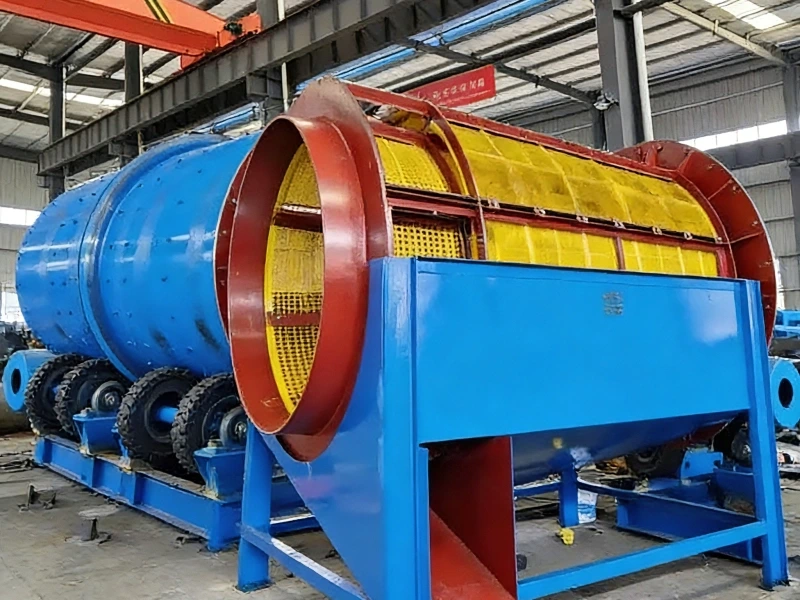
  • Step 1: Feeding & Sizing: A Vibrating Feeder introduces the raw material into a Trommel Scrubber, which thoroughly washes away sticky mud and screens the material into different size fractions.

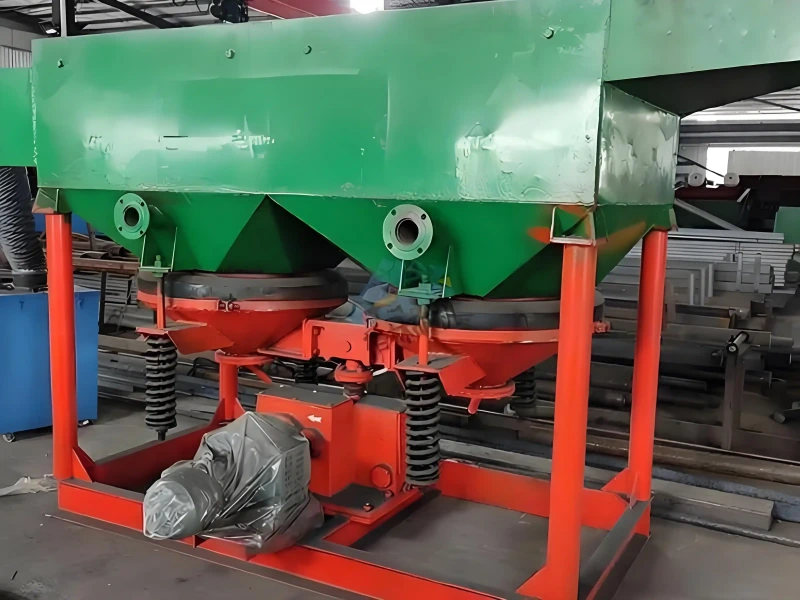
  • Step 2: Rough Gravity Separation: The coarse, cleaned particles enter a Jig Separator (a powerful gravity machine) for rough concentration. The oversized chunks are further reduced using a Double Roller Crusher and a Vibrating Screen to a fine sizing (under 2mm).

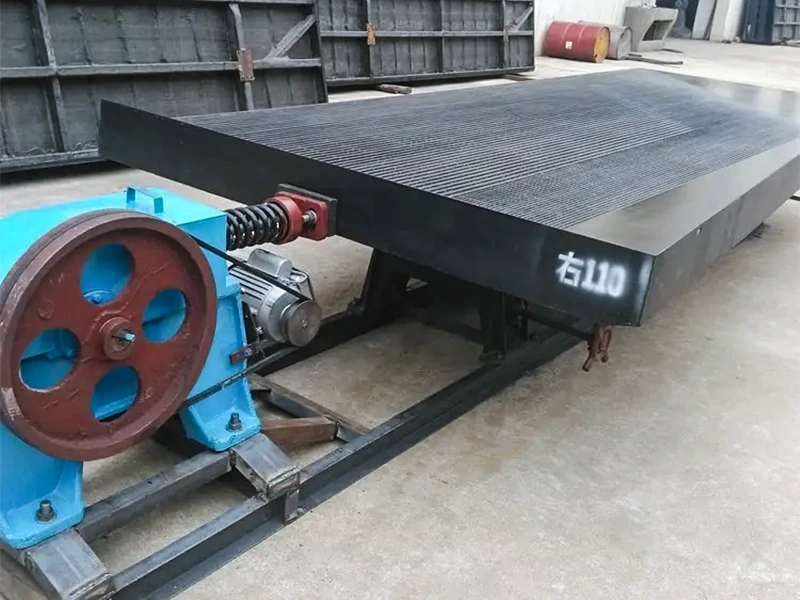
  • Step 3: Fine Gravity Cleaning: Finer ores and the under-screen slurry pass to Shaking Tables, which offer an exceptionally high recovery ratio for fine-grained coltan and cassiterite (tin).

  • Step 4: Sun Drying & Magnetic Cleaning: The collected wet concentrates are dried in the sun or a drying shed, then fed into a Three-Disc Dry Magnetic Separator to separate the pure coltan from the tin ore.

Solution 2: Hard Rock Coltan Crushing & Grinding Plant

This heavy-duty setup is customized for solid rock mines where minerals are tightly bound within host rocks.

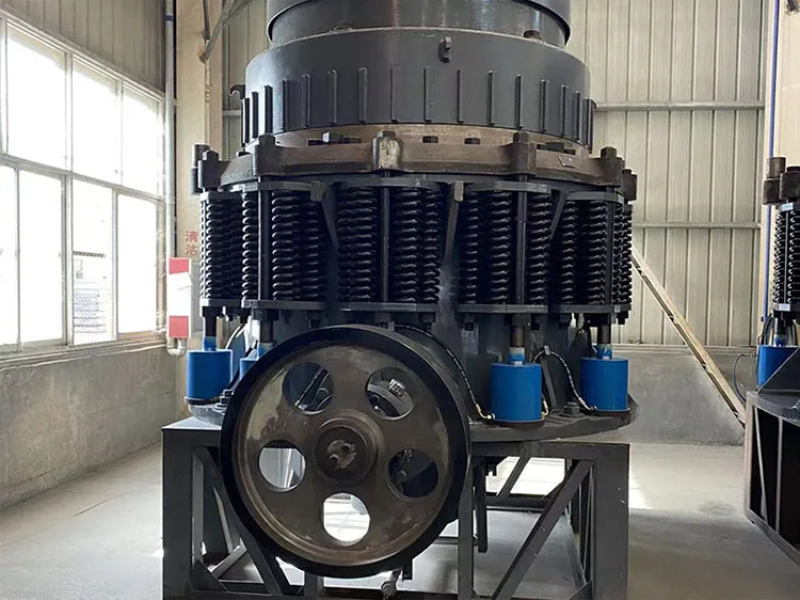
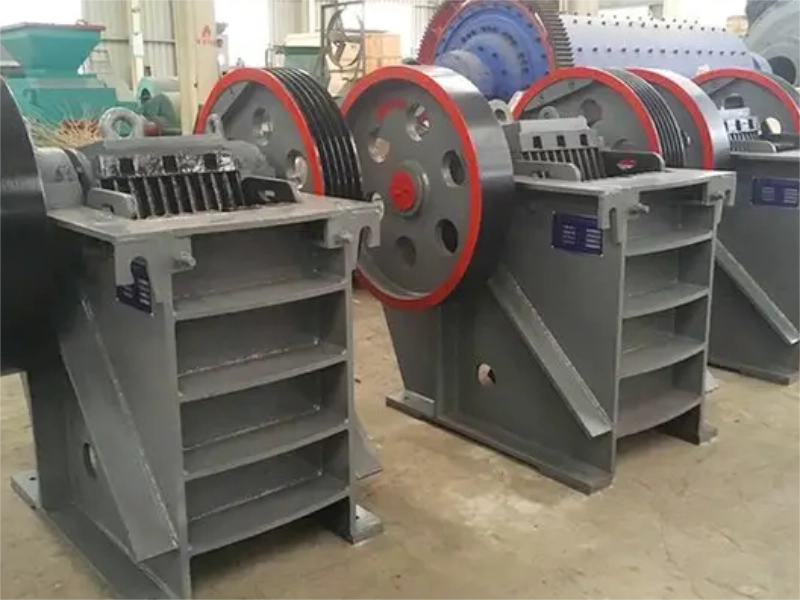
  • Step 1: Multi-Stage Crushing: Raw rocks are fed into a Jaw Crusher for primary crushing, then transferred to a Cone Crusher for fine secondary crushing. A Vibrating Screen ensures only particles under 30mm move forward.

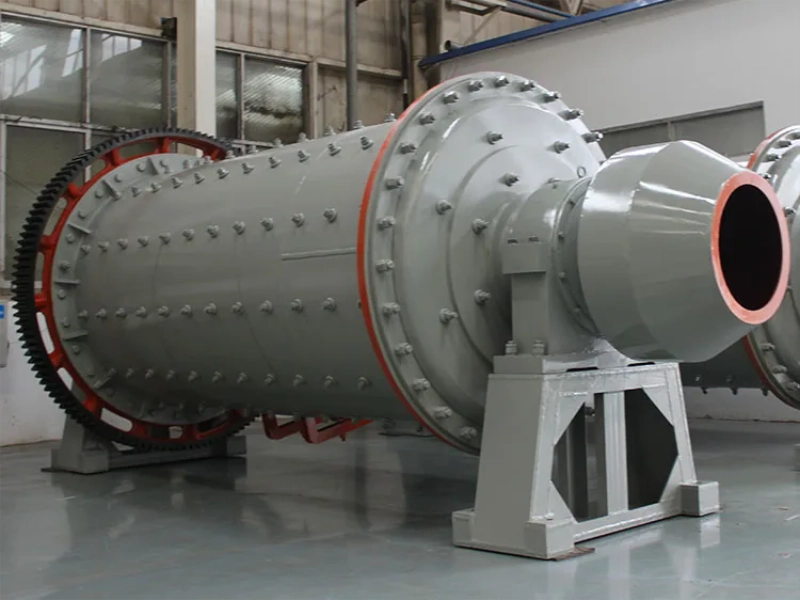
  • Step 2: Fine Grinding: The 0-30mm material is stored in a bin and continuously fed into a Hammer Crusher (or Ball Mill) to be pulverized into a 0-2mm fine slurry, fully liberating the coltan minerals.

  • Step 3: Dual-Stage Gravity Concentration: The 0-2mm slurry is pumped first to a Jig Separator to catch heavy elements. The discharge is then routed to a First-Stage Shaking Table, followed by a Second-Stage Shaking Table to re-process the middlings, achieving maximum recovery and purity.
  • Step 4: Dewatering & High-Intensity Magnetic Separation: The high-purity mixture is dewatered via a Dewatering Screen and dried. Finally, a High-Intensity Three-Disc Dry Magnetic Separator processes the dry mixture. By adjusting the magnetic intensity, it cleanly separates iron, ilmenite, hematite, coltan, and tin, delivering final concentrates with grades up to 60% – 65%.

Upgrade Your Mining Project with Expert Solutions

Choosing the right equipment determines your mine’s profitability. Whether you are dealing with alluvial clay or complex rock formations, custom-engineered mineral processing lines maximize your recovery rates while lowering operational costs. Contact our technical team today to get a tailored processing flow sheet and equipment quotation!

How to Optimize Gold Shaking Tables for Max Recovery

In the modern mineral processing landscape, gravity separation remains one of the most cost-effective, eco-friendly, and dependable beneficiation technologies for small and medium-scale mining operations. Among all gravity concentration equipment, the gold mining shaking table stands out as a classic, indispensable device engineered for fine-grained ore concentration.

Unlike chemical leaching or flotation systems that demand complex chemical reagents and stringent environmental clearances, gold shaking tables rely strictly on physical separation principles. They offer low energy consumption, zero chemical pollution, a high enrichment ratio, and excellent operational flexibility. For global small-scale gold miners, processing engineers, and mining investors, mastering the mechanics, field adjustment, and upkeep of shaking tables is the absolute key to maximizing gold recovery and boosting economic returns.

1. What is a Gold Mining Shaking Table?

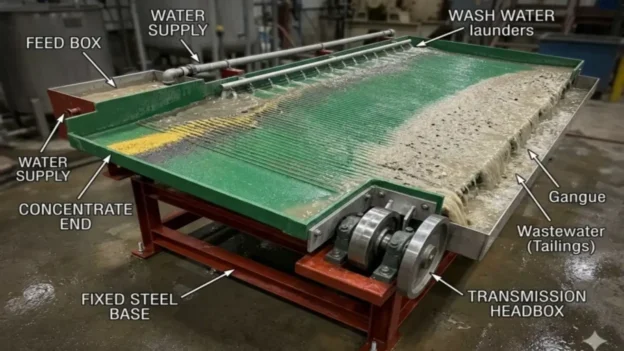
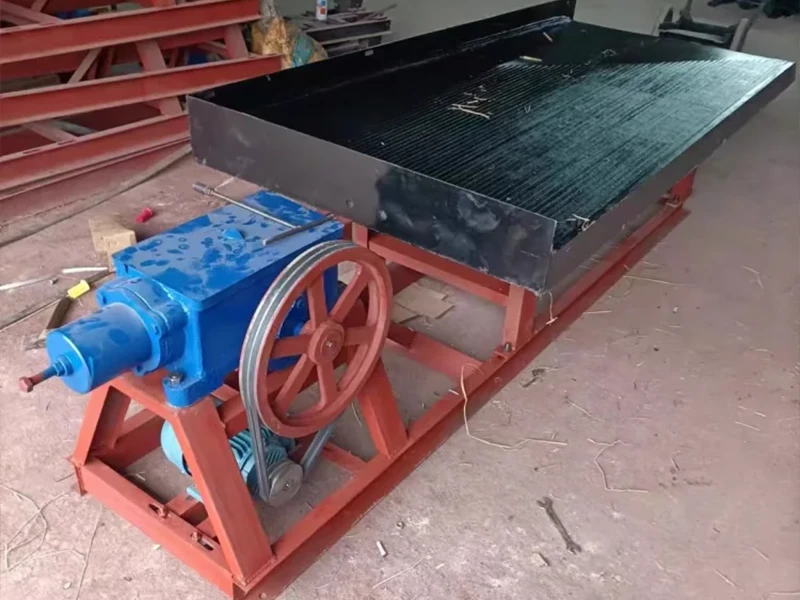
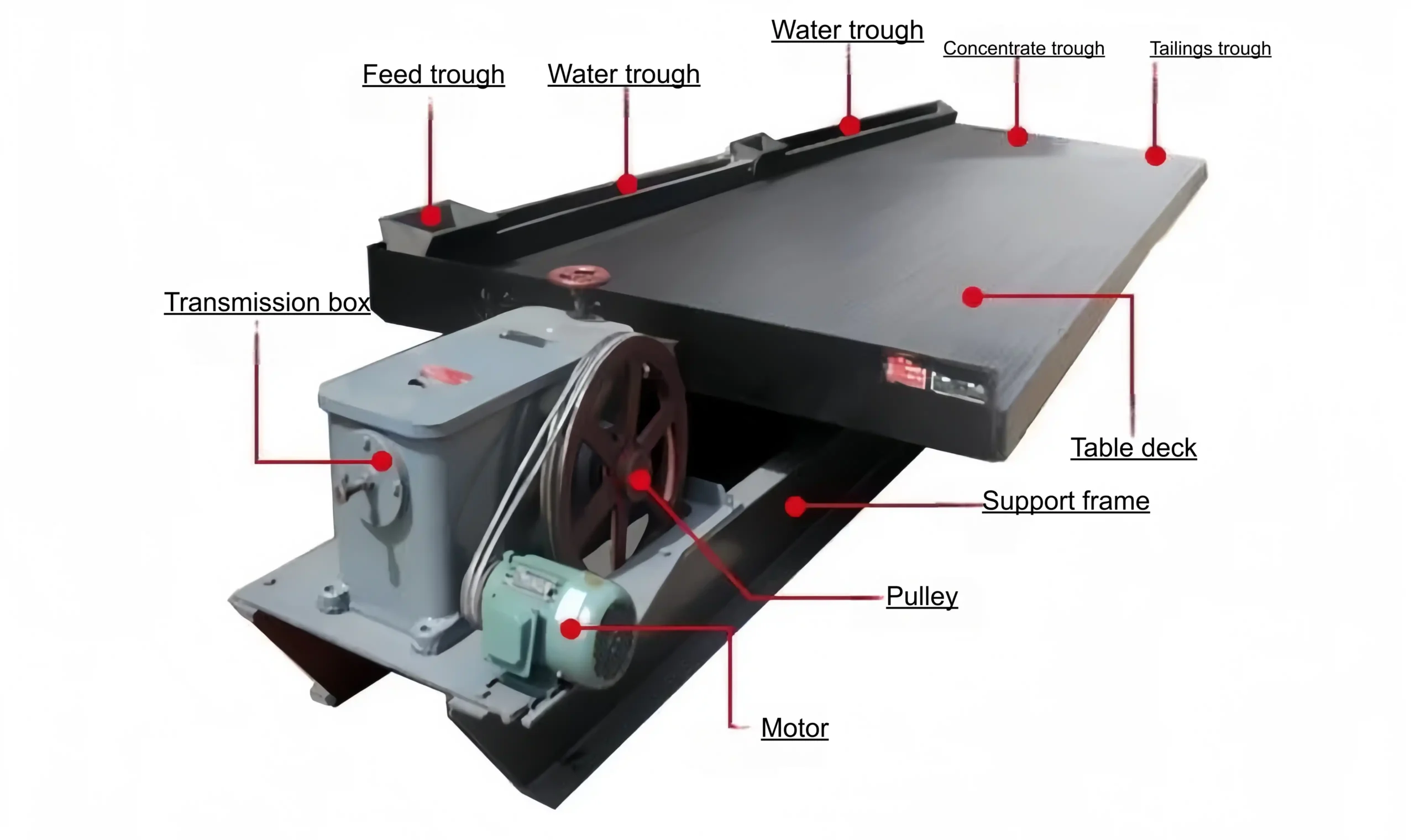
6S gold mining shaking table structure and main components

A gold mining shaking table—often referred to as a gravity concentrating table—is a specialized physical separation device designed to sort fine and micro-fine granular gold ores from heavy minerals and light gangue.

While highly celebrated for fine-grained monomer gold recovery that conventional jigging machines fail to capture, it is equally effective for processing silver, tin, tungsten, iron, and manganese.

Modern processing plants primarily utilize the 6S series gold shaking table. Decades of technical iterations have optimized the deck slopes, stroke frequencies, and water distribution configurations of this model, drastically increasing sorting accuracy and throughput compared to legacy designs. Because it features a compact structure, low operating costs, and simple installation without requiring massive infrastructure, it remains the preferred core equipment for grassroots mining sites and mobile placer gold operations worldwide.

2. Core Working Principle: The Physics of “Gold-Stone Separation”

The fundamental logic of a gold shaking table relies on density stratification combined with mechanical reciprocating motion and transverse water washing. This purely physical process guarantees high-purity gold recovery while remaining 100% compliant with global environmental protection standards.

The separation cycle occurs in three distinct, synchronized stages:

Stage 1: Density Stratification

The crushed gold ore slurry is introduced uniformly via the feed box onto the inclined deck. As the horizontal water flow hits the slurry, the mineral particles become suspended and loose.

Due to the massive density gap between gold particles and typical gangue rock, instant layering occurs:

  • Pure Gold Density: Approximately 19.3 g/cm3
  • Gangue Minerals (Quartz/Feldspar) Density: Approximately 2.6 – 2.8 g/cm3

The ultra-heavy gold particles plunge rapidly to the bottom layer, gripping the deck surface, while the light gangue minerals float to the upper layer of the slurry.

Stage 2: Asymmetric Reciprocating Shaking

Driven by a motor-linked transmission mechanism, the table deck moves in a precise, asymmetric reciprocating motion. The forward stroke is fast and short, while the return stroke is slow and long.

This creates a powerful inertial thrust that acts directly on the heavy mineral particles settled at the bottom. These gold and heavy sand particles are driven forward longitudinally toward the concentrate discharge end. Conversely, the upper-layer light gangue particles are cushioned by the water layer and do not experience this inertial push.

Stage 3: Transverse Water Washing and Final Sorting

A uniform film of wash water flows constantly down across the inclined deck. This cross-current sweeps the upper-layer light gangue minerals down toward the lower tailings discharge side.

As the minerals travel across the deck, they fan out based on their specific gravity and size. The clean gold particles aggregate at the far concentrate end, delivering high-grade gold sand and heavy mineral concentrates while waste rocks are discarded cleanly at the bottom.

3. Structural Composition and Technical Specifications

The operational stability and sorting precision of a shaking table depend heavily on the alignment of its five core structural components:

Component Technical Function & Material Composition
Corrugated Table Deck Fabricated from high-grade fiberglass, seasoned wood, or wear-resistant steel plates treated with anti-corrosion coatings. The surface features uniform riffles (corrugations) that block fine gold particles from being swept away by the water cross-current. The deck inclination angle can be mechanically adjusted based on mineral density and feed size.
Transmission & Stroke Mechanism Consists of an electric motor, a gear reducer, a crankshaft, and a connecting rod assembly. It dictates the stroke length (10 – 30 mm) and stroke frequency (200 – 350 strokes/min).
Water Supply System Comprises water distribution tanks, pipes, and flow control valves. Provides steplessly adjustable, uniform washing water across the deck to maintain the perfect slurry-to-water ratio.
Ore Feeding Device A specialized slurry feed box that evenly distributes the ore pulp in a fan shape across the deck, preventing local overloading or turbulence that disrupts mineral stratification.
Heavy-Duty Base Support A rigid steel chassis designed to handle high-frequency shaking vibrations without shifting. Equipped with level-adjustment bolts to calibrate the horizontal axis perfectly during installation.

Looking for reliable gravity separation equipment? Check out our industrial-grade 6S Gold Shaking Tables for sale with customizable configurations.

4. Primary Mining Application Scenarios

The shaking table is exceptionally versatile and is rarely limited to a single type of mining project. It is widely deployed across four major operational setups:

  • Fine-Grained Gold Processing (0.02 – 2 mm): Ideal for quartz vein gold, oxidized gold ores, and fine placer deposits. It acts as a safety net for micro-gold particles that typically escape downstream from jigs and sluices.
  • Middlings and Rough Concentrate Reprocessing: Rough concentrates extracted from sluice boxes, jigs, or centrifugal concentrators often retain heavy gangue minerals. Running these materials through a shaking table elevates the gold grade by multiple folds via precision cleaning.
  • Sulfide & Symbiotic Ore Separation: Effectively separates free gold from accompanying heavy sulfides like pyrite and chalcopyrite, while simultaneously isolating valuable base metals like tungsten, tin, and manganese.
  • Remote and Mobile Mining Operations: Compact and highly portable small-scale shaking table variants are easily mounted on mobile trucks or deployed in remote mountainous river basins with minimal infrastructure requirements.

5. Step-by-Step Installation and Commissioning Guide

Poor recovery rates on site are rarely caused by equipment failure; more often, they stem from improper leveling or uncalibrated stroke dynamics. Follow this standardized operational sequence to commission your shaking table:

  1. Step 1: Secure and Level the Chassis
    Select a solid, reinforced concrete or heavy timber footing. Place the machine and use the level-adjustment bolts along the steel frame to ensure the longitudinal axis of the table deck is perfectly horizontal. Tighten the foundation anchor bolts firmly to eliminate any chassis drift or unwanted harmonic vibrations during high-speed operation.
  2. Step 2: Connect and Test the Water Lines
    Hook up the main water pipes to the distribution tank. Test the control valves to verify that water discharges across the deck in a smooth, continuous fluid sheet. Check for dry spots, blockages, or high-pressure leaks.
  3. Step 3: Conduct a Mechanical Dry Run
    Wire the motor and execute an empty-load test run for 10 to 15 minutes. Monitor the transmission head box for abnormal knocking sounds, excessive heat, or uneven joint play along the connecting rod. Ensure the reciprocating motion behaves smoothly.
  4. Step 4: Live Slurry Tuning (The Operational Sweet Spot)
    Introduce a controlled volume of real ore slurry. Apply the tuning hierarchy: adjust water flow first, deck angle second, and stroke metrics third. Watch how the minerals fan out on the deck.

    • If fine gold particles are migrating into the tailings zone, the wash water volume or the cross-slope tilt is too aggressive and must be dialed back.
    • If the gold concentrate band is heavily contaminated with silica gangue, increase the wash water volume or refine the stroke frequency.
  5. Step 5: Lock Parameters
    Once a sharp visual boundary line separates the bright gold concentrate from the dark middlings and light tailings, lock down the deck inclination adjusters and initiate full-scale production.

6. Operational Protocols and Preventative Maintenance

6.1 Standard Operating Procedures

  • Maintain Steady Feeding: Slurry volume and pulp density must remain constant. Sudden spikes or drops disrupt the thin-film fluid dynamics on the deck, causing mineral stratification to collapse and forcing gold into the tailing lines.
  • Real-Time Band Monitoring: Operators must constantly inspect the concentrate discharge line. If the feed particle size shifts unexpectedly, real-time adjustments must be made to the wash water valves to protect recovery margins.

6.2 Maintenance Checklist

  • Post-Shift Flush: At the end of every operating shift, run clean water through the system to wash out all trapped slurry, grit, and sticky clays from the deck corrugations. This prevents dried ore from hardening inside the riffles and ruining the next day’s sorting performance.
  • Crankshaft Lubrication: The eccentric transmission head motion generates immense friction. Check oil levels in the main headbox daily and grease the connecting rods to avoid catastrophic mechanical wear.
  • Riffle Inspection: Over time, heavy abrasive sands will dull and round out the sharp edges of the deck corrugations. Replace or re-coat worn decks immediately; flat or worn riffles cannot trap fine gold particles.

6.3 Safety Redlines

  • Lockout/Tagout (LOTO): Never perform mechanical adjustments, parameter modifications, or deck cleaning while the machine is running. Always cut the primary power supply first.
  • Guards In Place: The drive belt and reciprocating connecting rods must be shielded by protective covers at all times. Keep hands entirely clear of moving components during operation.
  • Waterproof Grounding: Because gold shaking tables operate in wet, humid environments, all electric motors and control enclosures must feature proper grounding and moisture insulation to eliminate electrical leakage risks.

7. Strategic Advantages of Shaking Tables in Gold Processing

  • Zero Environmental Liability: Operating entirely via physical gravity principles, it bypasses the need for toxic chemicals like cyanide or mercury. This completely eliminates tailing pond chemical hazards and reduces local environmental assessment hurdles.
  • Superior Return on Investment (ROI): Boasting low initial capital costs, minimal power consumption, and zero chemical overhead, it provides an exceptional gold enrichment ratio that translates directly into immediate operational profitability.
  • Low Operational Barrier to Entry: The mechanical workflow is straightforward and highly automated. Operators do not require an advanced degree in metallurgy; local teams can master fine-tuning and operation after a few basic training sessions.
  • Excellent Process Resilience: It handles fluctuations in ore mineralogy, clay variations, and grain distribution gracefully via simple, on-the-fly manual screw adjustments.

8. Conclusion

The gold mining shaking table remains an industry-standard benchmark for high-efficiency, green gravity separation. Its reliance on basic physical separation mechanics, matched by steady operational delivery and nominal running costs, makes it an unmatched asset for extracting value from fine-grained gold ores. By mastering systematic installation, precise parameter tuning, and rigorous daily maintenance, mining operators can successfully maximize their gold recovery yields and unlock the full economic potential of their mineral reserves.

Explore Our Equipment: Browse our full catalog of heavy-duty Gold Shaking Tables and request a free quote today!

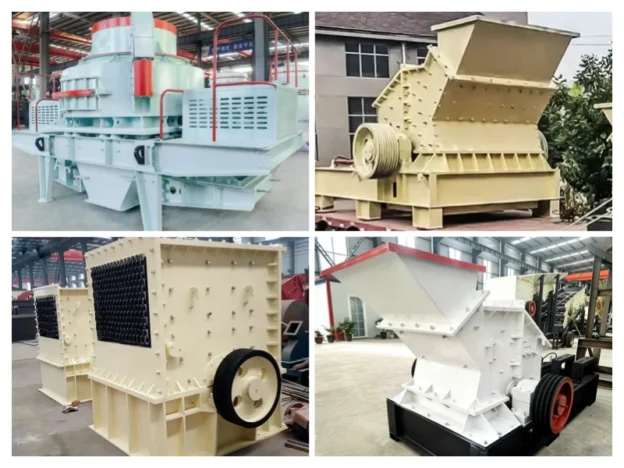
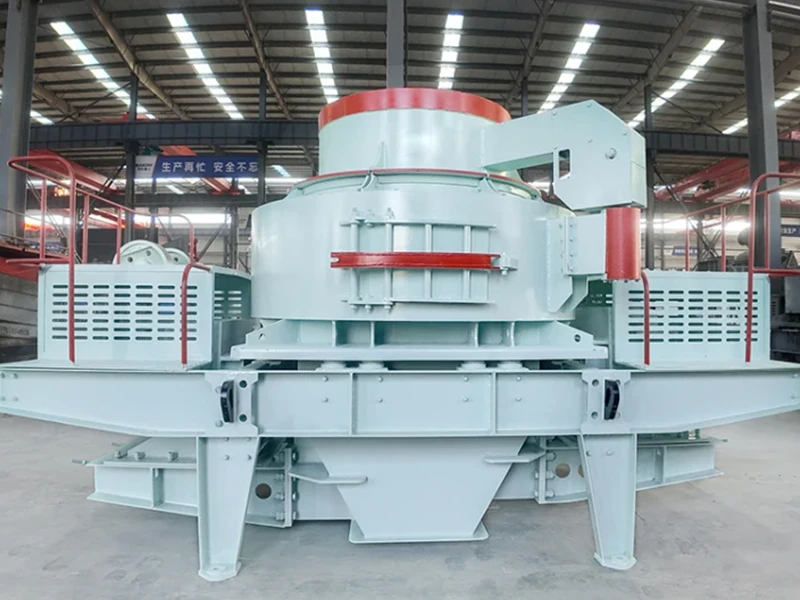
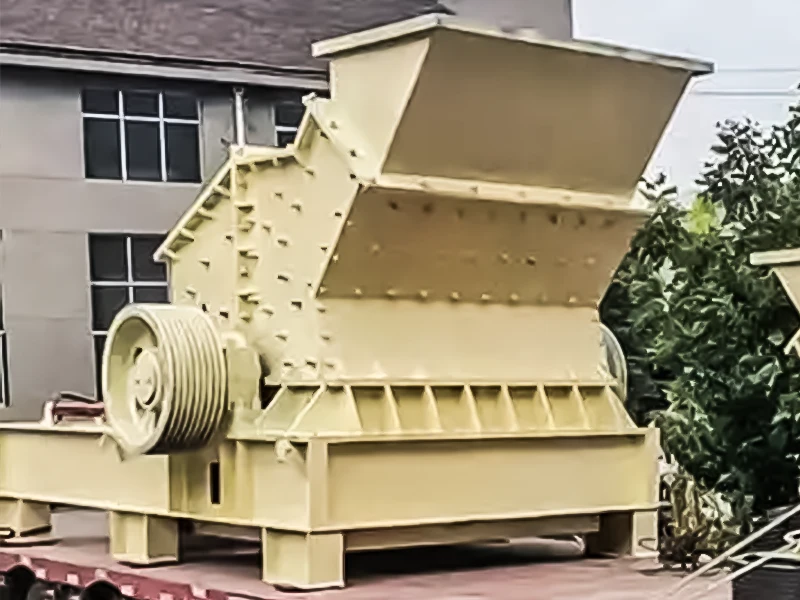
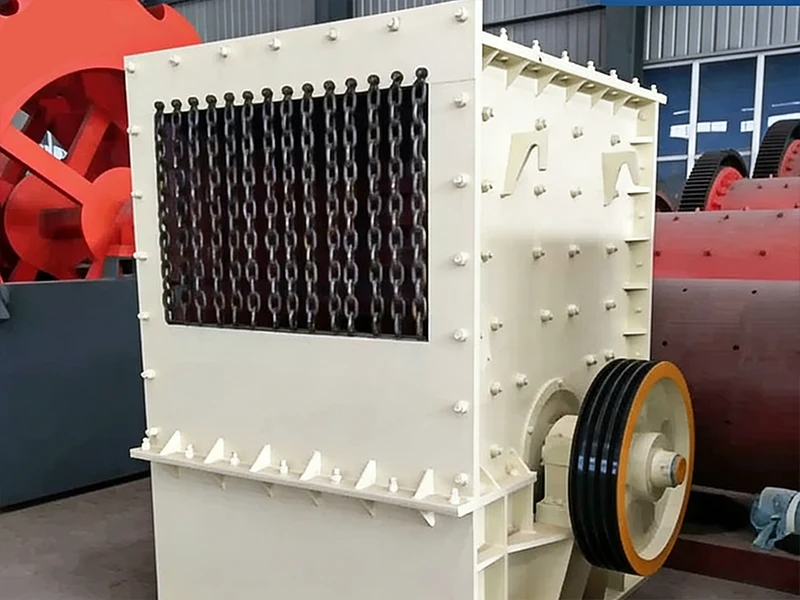
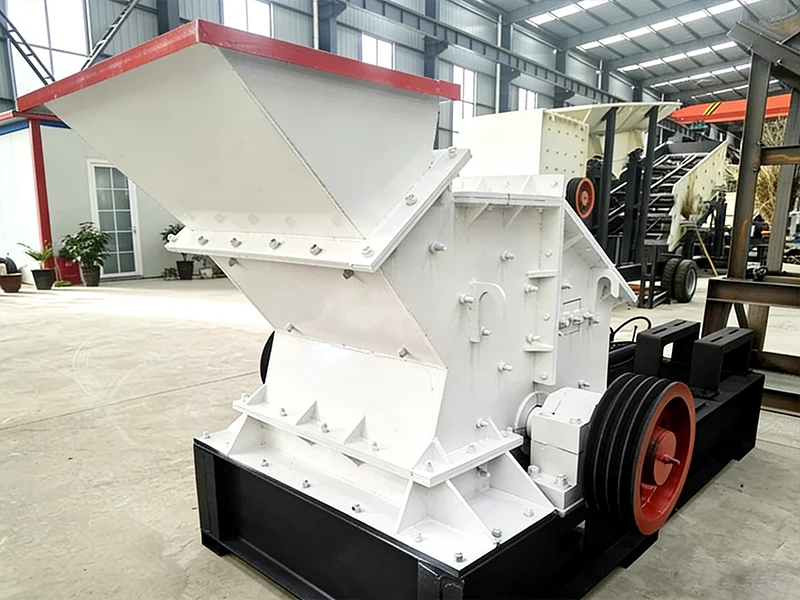
The Ultimate Guide to Choosing the Right Sand Making Machine: VSI, Impact, Box, or Hydraulic Open-Box Crusher?

When investing in a manufactured sand (M-Sand) production line, one of the most critical decisions quarry owners and mining engineers face is selecting the right crusher. The market offers various types of sand-making equipment, each engineered with distinct principles, capacities, and materials in mind. Choosing a mismatched machine can lead to high wear-part costs, poor aggregate shape, or insufficient production rates.

In this comprehensive guide, we will break down the four core types of sand making machines—VSI (Vertical Shaft Impact) Crusher, Impact Crusher, Box Crusher, and Hydraulic Open-Box Crusher—to help you identify the absolute best fit for your specific project.

1. Quick Comparison: Key Specifications At a Glance

Before diving into the detailed mechanics, let’s compare the key engineering parameters of these four heavy-duty sand makers to see which one aligns with your capacity and feed size requirements.

Machine Type Max Feed Size (mm) Production Capacity (t/h) Motor Power (kW) Best Suited Materials
VSI / Centrifugal Crusher Up to 60 mm 24 – 1100 t/h 30 – 2×500 kW Hard rocks (Granite, River Pebble, Basalt)
Impact Crusher Up to 700 mm 15 – 500 t/h 45 – 2×250 kW Soft to medium-hard rocks (Limestone, Dolomite)
Box Crusher Up to 1200 mm 50 – 400 t/h 45 – 280 kW Massive raw stones (Granite, Pebble, Waste concrete)
Hydraulic Open-Box Crusher Up to 190 mm 20 – 300 t/h 30 – 315 kW Medium-hard rocks & tailings (Pebble, Granite)

2. In-Depth Breakdown of the 4 Sand Making Technologies

Type A: VSI Sand Making Machine (Centrifugal Crusher)

The VSI Sand Making Machine is the undisputed flagship equipment for large-scale, premium manufactured sand production lines. It utilizes a high-torque rotor and optimized crushing cavity to achieve superior fine crushing and vertical shaping.

  • Exceptional Cubical Particle Shape: By employing an advanced “rock-on-rock” or “rock-on-iron” shaping process, it outputs perfectly rounded sand with zero flaky or needle-like particles. This fully complies with strict international standards for high-grade construction aggregate.
  • Premium Wear Resistance: The impact blocks and liners are forged from premium high-chromium alloy, drastically enhancing the lifespan of highly vulnerable components.
  • Continuous 24/7 Operations: Thanks to a heavy-duty welded chassis and precise dynamic balance engineering, it generates minimal vibration and low noise, supporting non-stop industrial scaling.

Best Applications: Perfect for large sand and gravel plants handling highly abrasive materials like river pebbles, granite, basalt, quartz, and copper ore.

Type B: Impact Sand Making Machine

Designed as an efficient solution for soft and medium-hard materials, the Impact Crusher integrates a dual-action “Impact + Counter-attack” mechanism. Materials are repeatedly struck against the high-chromium blow bars and impact plates for simultaneous crushing and grinding.

  • Massive Crushing Ratio (Up to 40:1): It completes primary, secondary, and shaping stages in a single pass. This heavily simplifies the downstream workflow and lowers your overall capital expenditure (CapEx).
  • Adjustable Output Fineness: Operators can easily adjust the clearance between the impact plate and the blow bars to gain precise control over the output size distribution.
  • Quick 10-Minute Maintenance: Built with a specialized hydraulic open-top cover, wear parts can be inspected and replaced in less than 10 minutes without requiring large, expensive hoisting cranes.

Best Applications: Ideal for crushing limestone, dolomite, shale, gypsum, coal gangue, and recycling concrete waste for high-speed rail and bridge construction.

Type C: Box Sand Making Machine

The Box Crusher is a heavy-duty powerhouse specifically engineered to take on massive raw boulders directly. Featuring an extra-large feed inlet, a square box enclosed chamber, and a heavy-duty hammer design, it eliminates the need for a preliminary jaw crusher.

  • Eliminates Pre-Crushing Stages: With its ability to accept raw stones up to 1200mm in size, it directly skips the traditional primary crushing step. This reduces aggregate handling steps, machinery footprints, and initial investments.
  • Unmatched Versatility (“Eat All” Capability): The reinforced heavy hammers and thick-walled crushing walls provide incredible kinetic impact force, allowing it to easily crush hard river stones, granite, and giant construction debris alike.
  • Enormous 50:1 Crushing Ratio: A single raw input results in fine, well-graded manufactured sand with uniform structural geometry.

Best Applications: Large sand plants, mountain mining quarries, and massive infrastructure projects looking to process large-sized rocks efficiently on-site.

Type D: Hydraulic Open-Box Sand Making Machine

The Hydraulic Open-Box Sand Making Machine combines the reliable composite crushing principles with an ultra-convenient mechanical structure. It serves as the ultimate core equipment for small-to-medium-sized aggregate plants.

  • One-Click Hydraulic Hood: The standout feature is its automated hydraulic opening structure. Changing hammers and internal liners takes only 5 to 10 minutes, entirely cutting down operational downtime losses.
  • Highly Flexible & User-Friendly: The discharge gap can be fine-tuned to precisely deliver precise 0-5mm sand sizes. Even novice operators can master the settings within hours.
  • Self-Shaping Efficiency: The continuous high-speed kinetic force guarantees smooth, rounded sand grain morphology that prevents clogging in concrete mixing.

Best Applications: Medium-to-small aggregate quarries, modular construction sites, mining tailings recovery, and environmental urban waste processing plants.

3. How to Choose the Perfect Match for Your Site?

To finalize your decision, ask yourself these three core project questions:

  1. What is the hardness of your raw material? If you are crushing hard granite or river quartz, choose the VSI Crusher or Box Crusher. For softer stones like limestone or gypsum, the Impact Crusher offers the highest ROI.
  2. What is your maximum raw material size? If your stone is huge (over 500mm) and you want to avoid buying a primary jaw crusher, go with the Box Crusher. If the stone is pre-crushed (under 60mm), the VSI Crusher will yield the finest sand quality.
  3. What is your target hourly budget & maintenance scale? For smaller setups demanding quick, hassle-free maintenance without heavy equipment cranes, the Hydraulic Open-Box Crusher is your best bet. For high-volume mass production up to 1000+ TPH, invest in a heavy-duty VSI system.

Get a Professional, Factory-Direct Sand Production Layout

Still unsure which sand-making machine configuration fits your terrain, rock properties, and budget? We can help.

As a premier manufacturing factory, Dayang provides turnkey engineering designs. Our professional mineral processing engineers will map out a customized dynamic production flowchart, optimize equipment selections, and offer factory-direct wholesale pricing to maximize your operational ROI.

Contact our engineering support team today to get a free project layout design and a quick quotation!

From Hard Clay to Quicksand: How to Optimize Dredging Efficiency with Dayang

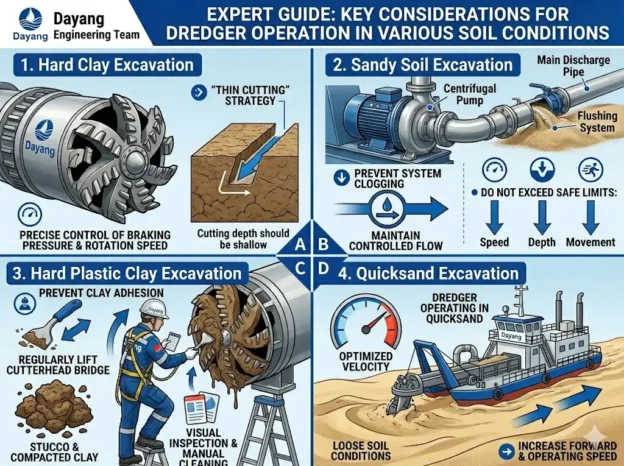
A dredger is a specialized vessel designed for efficient water dredging, separation, and extraction of sand and sediment. Investing in the right technology—like the systems developed by Dayang—can deliver significant operational and economic benefits. To ensure maximum yield and prolong the service life of your equipment, following proper operational methods is essential.

Different soil conditions require specific operating protocols to prevent blockages, maintain efficient throughput, and avoid excessive wear. Our Dayang Engineering Team has compiled these key points to consider during excavation.


Soil-Specific Operation Protocols

1. Excavating Hard Clay

When dealing with hard clay that has low moisture content, the operator must exercise precise control over the cutterhead’s braking pressure and rotational speed. A thin-cutting strategy is critical; the depth of each pass should be shallow to avoid overwhelming the system.

2. Excavating Sandy Soil

Sandy soil is loose and characterized by coarse particles, making it prone to causing blockages. During excavation, the forward movement, dredging depth, and travel speed must not be excessive. Maintaining a controlled flow is crucial for preventing the system from becoming choked.

3. Excavating Hard Plastic Clay

The primary challenge with hard plastic clay is its tendency to adhere to the machinery. To prevent the clay from sticking to and clogging the cutterhead, the operator must regularly lift the ladder/cutterhead for visual inspection and manual cleaning during the operation.

4. Excavating Quicksand

Quicksand typically poses less resistance, allowing for a more aggressive approach. To maximize efficiency in these loose conditions, the dredger’s forward movement and overall speed can be appropriately increased.


Conclusion

Mastering these soil-specific techniques is the key to maintaining a highly productive and long-lasting dredging operation. By integrating these practices with Dayang’s robust engineering, you ensure that your equipment delivers maximum value over its entire lifecycle.

Do you have specific questions about optimizing your dredger for complex soil conditions? Our Dayang technical experts are available for a customized consultation.

Ensuring Peak Performance: The Essential Guide to Dredger Operation and Maintenance

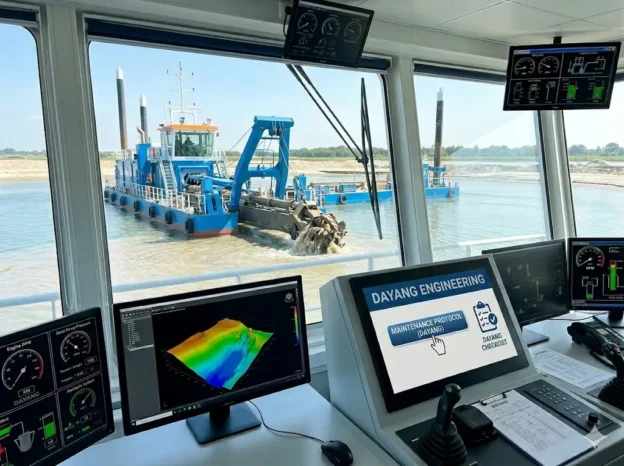
In large-scale dredging operations, your equipment is your most valuable asset. Any mechanical failure doesn’t just stop the machine—it will halt your entire project’s progress. To safeguard your investment and ensure maximum uptime, our engineering team has outlined the standard Operational Protocol and Preventive Maintenance guidelines.


I. The Pre-Production & Startup Phase

A smooth startup is the foundation of a trouble-free workday. Follow these critical steps:

  • Thermal Stabilization: After starting the engine, allow it to idle for approximately 10 minutes. This ensures the water temperature, oil temperature, and oil pressure reach optimal operating levels before any load is applied.
  • Power Activation: Before engaging the sand pump, ensure the 24V power supply on the main control cabinet is switched on.
  • Submersion & Priming: Lower the ladder and suction pipe until the cutterhead is fully submerged. Activate the flushing pump to prime the system and clear the intake.
  • Controlled Engagement: Engage the gearbox and sand pump via the control panel. Gradually ramp up the engine speed to the rated RPM. Note: Never engage the system at high speeds to avoid mechanical shock.
  • Production Commencement: Once the discharge pipeline is functioning with steady water flow, activate the cutterhead and begin the lateral movement for production.

Pro Tip: During operation, never insert the positioning spuds into the sediment while performing radial movements to avoid structural stress.


II. Real-Time “Sensory” Monitoring

A skilled operator is the first line of defense against equipment failure. While the machine is running, personnel in the engine room must perform a “Five-Sense Check”:

  • Listen: For abnormal vibrations or mechanical clanking.
  • Smell: For burnt oil, electrical scorching, or fuel leaks.
  • Observe: Constantly monitor the hydraulic system for leaks and check the engine’s “Three Leaks” (Water, Oil, and Air).
  • Monitor: Watch the instrumentation for any fluctuations in cooling or hydraulic pressure.

III. The Secure Shutdown Protocol

The way you stop the machine is as important as how you start it. To prevent sediment buildup in your pipes:

  1. Pipeline Flushing: Lift the cutterhead from the sand layer but continue pumping water. This flushes out remaining sediment from the entire discharge pipeline to prevent clogging.
  2. Deceleration: Gradually reduce the engine speed to disengage the sand pump and gearbox.
  3. Lifting & Securing: Raise the ladder winch until the cutterhead is completely clear of the water and secure it with all safety locks.
  4. Final Checks: Only after the engine has cooled down should it be stopped. Before departing, close the seabed valves and all other intake/outtake valves.
  5. Site Security: Disconnect the power supply and ensure all windows and doors are secured.

Conclusion

Proper operation is the best form of maintenance. By following these steps, you not only increase the efficiency of your dredging project but also significantly extend the service life of your machinery.

Looking for high-performance dredging solutions or technical support? 

The Future of Placer Mining: Why Remote Control Crawler Gold Wash Plants are Changing the Game

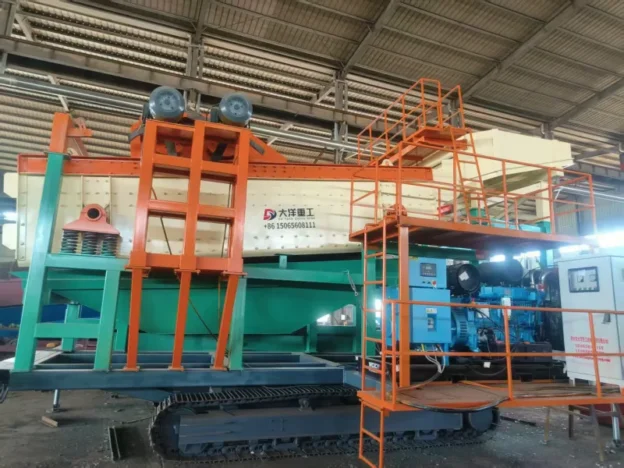
In the increasingly competitive world of placer gold mining, operational efficiency, safety, and rapid deployment are no longer luxuries—they are absolute necessities. Traditional, fixed gold wash plants, though powerful, often fail to meet the challenges of dynamic mining environments and difficult terrains. This is where the Remote Control Crawler-type Gold Wash Plant from dredgerfactory.com enters the scene, offering a revolutionary approach to mobile alluvial mining.

Core Advantages

1. Ultimate Mobility and Terrain Adaptability (Crawler Chassis)

The single biggest drawback of traditional plants is their dependency on smooth, prepared surfaces and the complex logistics required to move them. A Crawler-type chassis solves these problems:

  • Access Remote Ore Bodies: Move your plant directly to the richest ore zones, regardless of mud, steep slopes, or rough ground, which are inaccessible to wheeled trucks or fixed skids.
  • Follow the Vein: Placer gold deposits are rarely fixed in one spot. A self-propelled crawler allows you to advance the machine as you excavate, keeping the wash plant close to the digging face and minimizing haulage distance.

2. Superior Operator Safety and Precision (Remote Control)

Operating heavy machinery in active mining sites involves inherent risks. Incorporating Remote Control technology is a major leap forward in safety standards:

  • Operator Safety First: The operator controls the machine from a safe distance, away from the dust, noise, vibrations, and risks of material falls near the vibrating screens and feeding hopper.
  • Precision Maneuvering: Remote controls allow for incredibly precise positioning during feeding and movement, reducing accidental damage to the machine structure.

3. Rapid Deployment and Plug & Play Operation (Self-Propelled)

  • Arrival to Work in Minutes: The moment the unit arrives at the site, it is ready to move and start processing. There is no need for time-consuming foundation building or complex disassembly for transport.
  • Minimized Downtime: Scheduled moves between mining sections, which used to take days of cranes and logistics, are now done in minutes under the machine’s own power.

Technical Support and Fuel Economy

A mobility system is only as good as the power behind it. Our 300 TPH Crawler Gold Wash Plant is integrated with an Original WEICHAI 200kW Diesel Generator Set. This ensures:

  • Reliable Power: Rugged Weichai power for continuous 24/7 operation in remote areas.
  • Exceptional Fuel Efficiency: Consuming only 50L per hour at full power—significantly lowering your cost-per-ton.

Conclusion: The Remote Control Crawler-type Gold Wash Plant is not just an equipment upgrade; it is a strategic investment in the future of your mining operations. By combining heavy-duty processing power with ultimate mobility and operator safety, this unit ensures maximum gold recovery rates while minimizing operational costs.

Contact us for a detailed technical catalog and factory quote.

300 TPH Remote Control Crawler Gold Wash Plant


Our Remote Control Crawler-type Gold Wash Plant is the ultimate solution for professional miners operating in challenging terrains. Combining heavy-duty processing power with unprecedented mobility, this unit allows you to follow the ore vein and start processing the moment you arrive at the site.

Key Features

  • Ultimate Mobility: Equipped with a remote-controlled crawler chassis, this machine navigates mud, slopes, and rugged terrain without the need for additional towing equipment.
  • Strong Power Core: Powered by an Original WEICHAI 200kW Diesel Generator Set, ensuring 24/7 continuous operation for heavy-duty mining.
  • Exceptional Fuel Economy: Engineered for maximum efficiency, consuming only 50L per hour at full power load, significantly reducing your operational costs.
  • High Recovery Rate: Features an optimized sluice system designed to capture fine gold particles and prevent “gold loss,” maximizing your ROI.
  • Plug & Play: No complex foundation or site preparation required. Deploy and start mining in minutes.

Technical Specifications

Specifications Details
Processing Capacity 300 Tons Per Hour (TPH)
Power Source Original WEICHAI 200kW Diesel Generator
Fuel Consumption Approx. 50 L/Hour (Full Load)
Mobility Remote Controlled Crawler-type Self-propelled
Control System Industrial Wireless Remote Control
Application Gold Mining / Alluvial Mining Projects Only

Why Choose Our Self-Propelled Gold Mining Plant?

Unlike traditional fixed or skid-mounted plants, our crawler-based solution addresses the biggest headaches for mine owners: relocation costs and infrastructure setup. With a processing capacity of 300 TPH and a fuel-saving Weichai 200kW engine, this machine is a strategic investment that scales with your production goals while keeping overhead low.

Safety First: The remote control system allows operators to manage the plant from a safe distance, away from the dust, noise, and vibration of the vibrating screens and feeding zones.


Request a Quote

Are you ready to optimize your gold recovery? Contact us today for a detailed technical catalog and factory-direct pricing for our 300 TPH Remote Control Crawler Gold Wash Plant.

Visit us at dredgerfactory.com or DM for more information.

Revealing National Heavy Equipment: Full Analysis of Large Cutter Suction Dredger

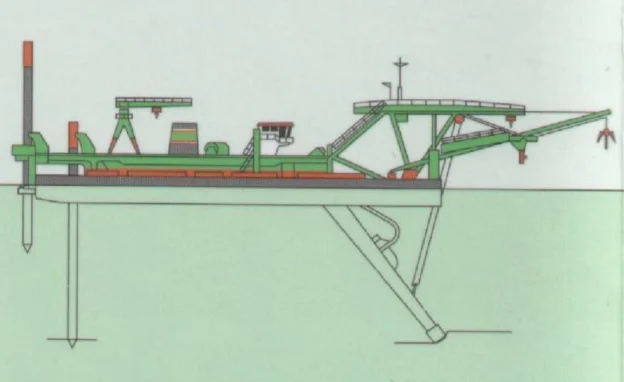
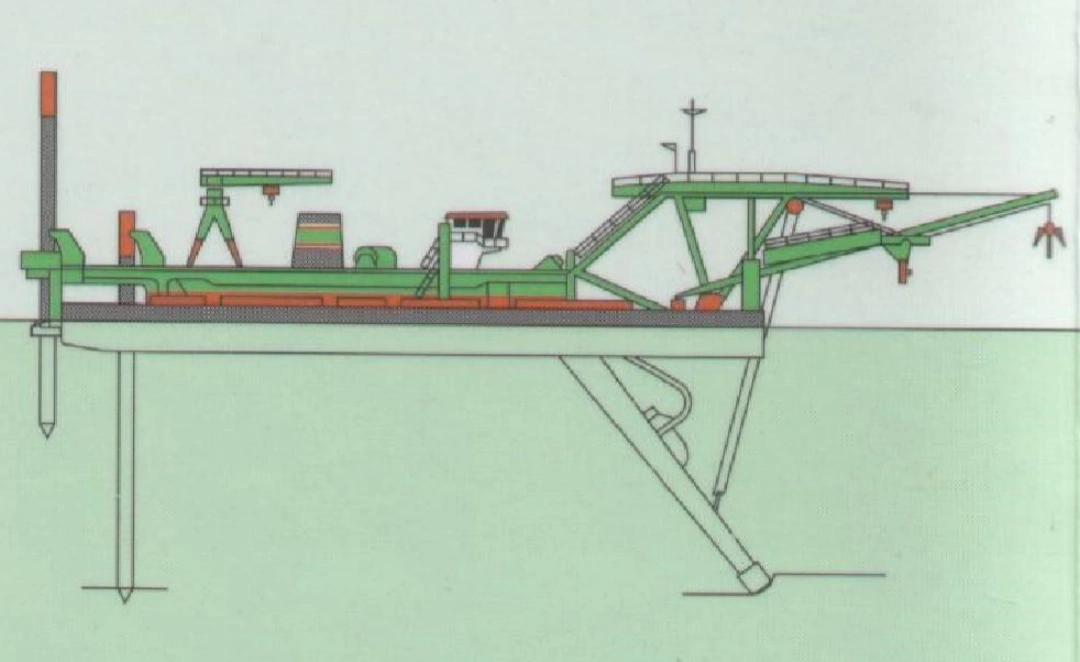
The cutter suction dredger is essential equipment for port dredging and land reclamation. With high-efficiency excavation, long-distance delivery and continuous working ability, it is one of the most important heavy equipment in modern dredging projects. This article explains the structure, working process and key technologies of a large cutter suction dredger.


1. Core Equipment

Key components of the dredger:

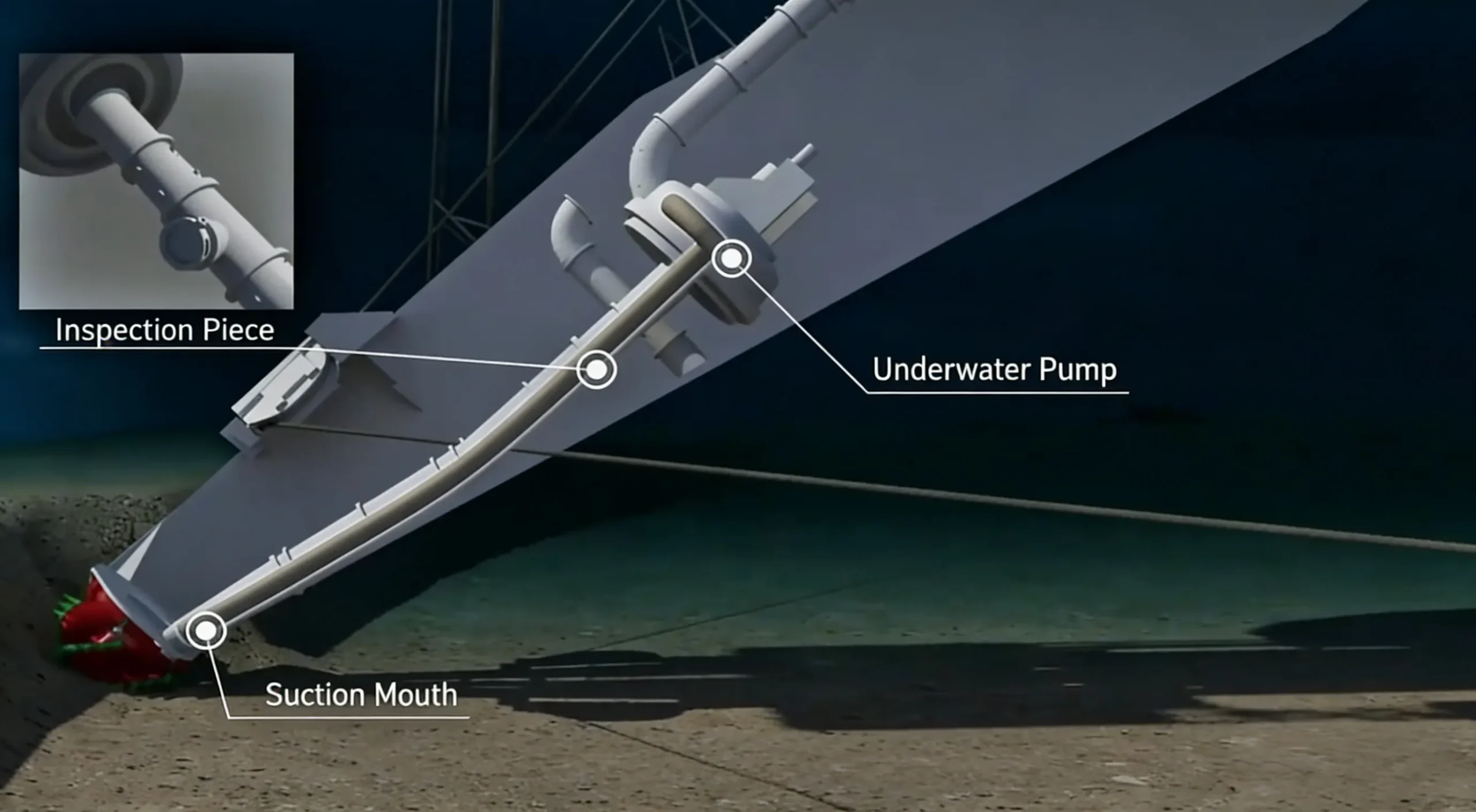
  • Cutter Head: Rotating cutting tool at the front of the ladder, loosens sediment.
  • Ladder & Lifting System: Supports the cutter and pump, controls digging depth.
  • Underwater Pump: Creates vacuum to suck slurry into pipelines.
  • Spud & Spud Carriage: Positions, swings and moves the vessel.
  • Inboard Multi-stage Pumps: Boost pressure for long-distance delivery.
  • Pipelines: Floating, sunken and shore pipes form long transport lines.
  • Barge Loading System: Transfers mud to barges for long-distance transport.

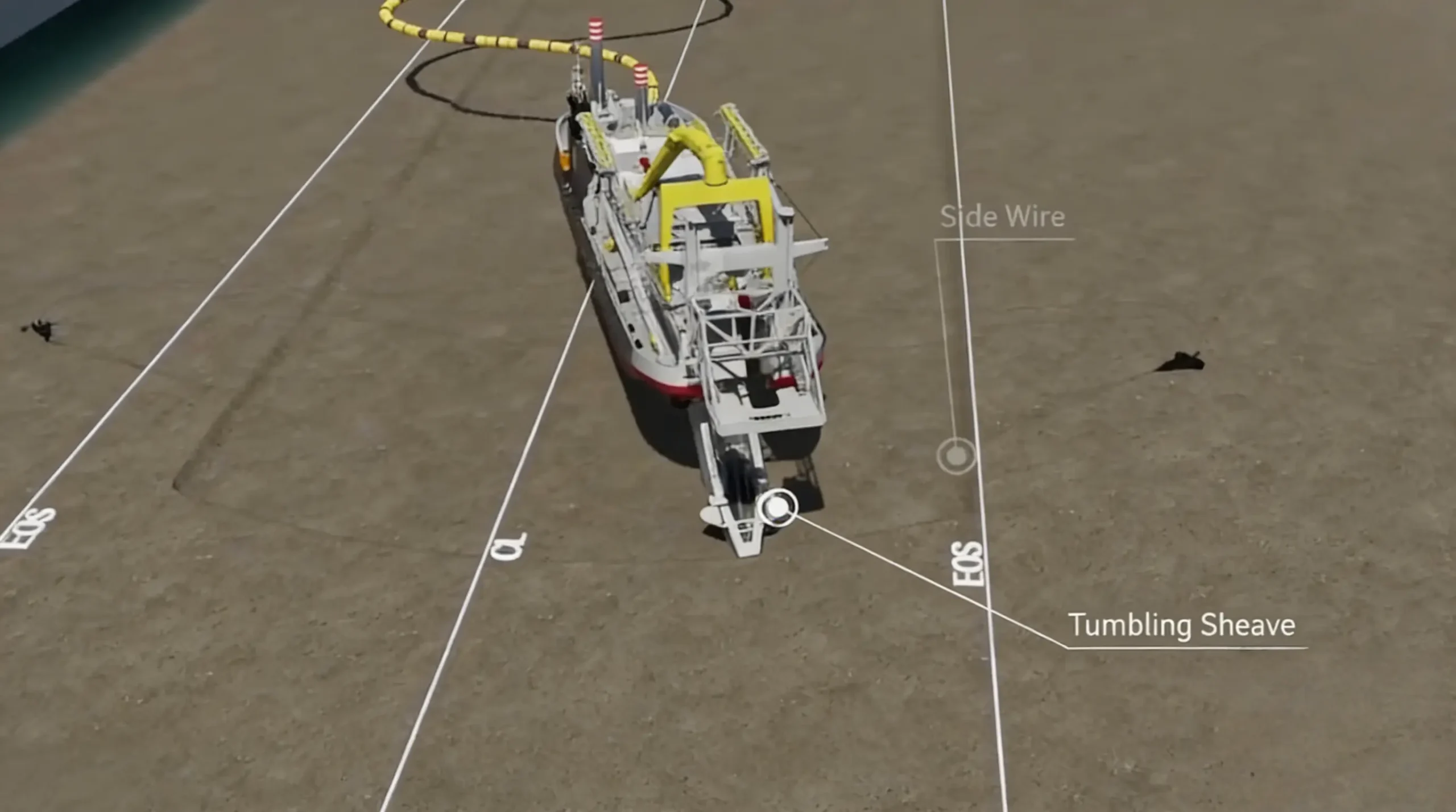
2. Fan-shaped Excavation

  1. The spud is inserted into the seabed for positioning.
  2. Winches pull cables to make the hull swing left and right.
  3. The cutter head rotates and excavates continuously.
  4. High efficiency and wide coverage for waterway dredging.

Dredger sectoral operation

3. How It Moves Forward: Step-by-Step Spud System

  1. After one section, the auxiliary spud lowers to fix.
  2. Main spud lifts; hydraulic carriage moves the hull forward.
  3. Main spud lowers again; auxiliary spud lifts.
  4. Cycle repeats for stable forward movement.


4. Slurry Transportation Process

  1. Cutter loosens sediment.
  2. Underwater pump sucks slurry.
  3. Multi-stage pumps boost pressure.
  4. Slurry flows through pipes to the reclamation area.
  5. Leveled by machinery to form new land.

Dredger Slurry Transportation

5. Barge Loading Operation

  1. A hopper barge berths alongside the dredger.
  2. Loading boom lowers into the barge hold.
  3. Slurry is evenly injected with energy dissipators.
  4. Barge moves synchronously and sails to dumping area.


6. Key Points Summary

  • Cutter Head: Cuts and loosens soil.
  • Spud Carriage: Step-by-step moving.
  • Multi-stage Pumps: Ensure long-distance delivery.
  • Reclamation: Creates new land with slurry.
  • Barge Loading: Long-distance mud transport.


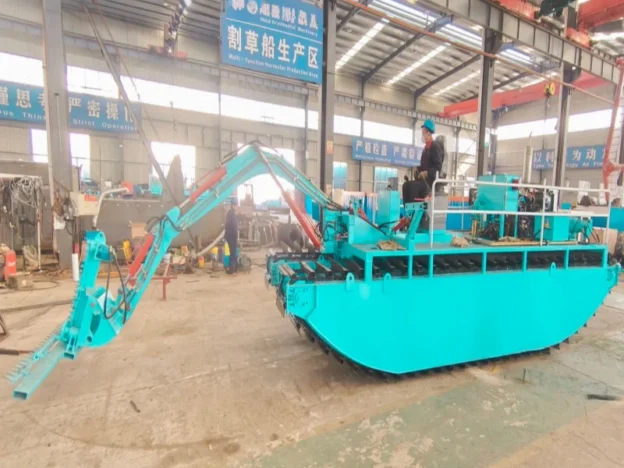
Amphibious Tracked Weed Harvester | All-Terrain Aquatic Vegetation Remover

Pro-Series Amphibious Tracked Weed Harvester

Our Pro-Series Amphibious Weed Harvester is a versatile, heavy-duty machine designed for the world’s most challenging aquatic environments. Combining the mobility of a tracked vehicle with the efficiency of a professional harvester, it transitions seamlessly from dry land to swampy marshes and deep water. Specifically engineered for the dense vegetation of South American river systems, it is your best partner for environmental restoration and waterway maintenance.


Technical Specifications

Item Specification
Model DY-200 / DY-300 Series
Drive System Dual-Mode: Hydraulic Crawler Tracks & Paddle Wheels
Engine Weichai / Cummins Turbocharged
Cutting Width 2,500mm – 4,000mm (Customizable)
Loading Capacity 3 – 8 Tons (Depending on Model)
Hull Material 6mm – 8mm Marine-grade High Strength Steel
Operation Depth 0 – 2.5 meters

Key Product Features

  • All-Terrain Mastery: Reinforced rubber tracks allow operation on mud, sand, and slopes where traditional boats cannot reach.
  • High-Torque Cutting System: Heavy-duty horizontal and vertical cutters slice through thick, fibrous water hyacinth and reeds.
  • Anti-Entanglement Design: Shielded propulsion system ensures continuous operation in dense weed mats without clogging.
  • One-Man Operation: Advanced hydraulic joystick control reduces labor costs and operator fatigue.
  • Eco-Friendly Performance: Low ground pressure design protects riverbeds and sensitive aquatic ecosystems.

Ideal Application Scenarios

  • Amazon Basin Cleanup: Controlling invasive water hyacinth in large river systems.
  • Swamp & Marshland Restoration: Cleaning wetlands with fluctuating water levels.
  • Hydroelectric Dam Maintenance: Preventing plants from clogging turbines and intake structures.
  • Municipal Canal Cleaning: Maintenance of city drainage and flood control channels.
  • Private Lake Management: Clearing overgrown vegetation in resorts and estates.

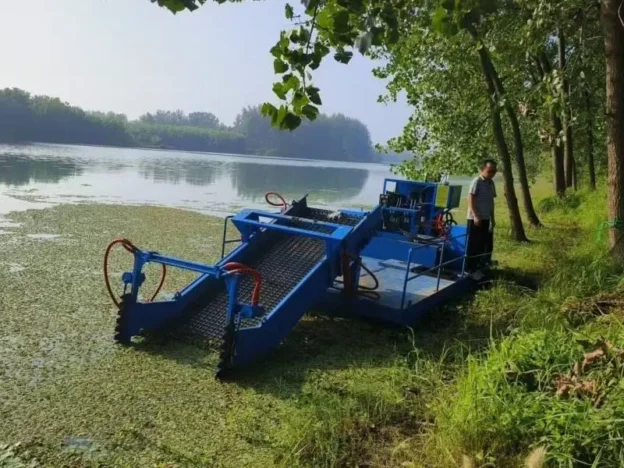
Automatic Small-sized Aquatic Weed Harvester / River Cleaning Boat

Our small-sized aquatic weed harvester is a versatile solution for municipal lake maintenance and private pond cleaning. It efficiently handles various water plants like water hyacinth, duckweed, and algae while collecting surface trash.

Technical Specifications

Parameter Details
Cutting Width 1200mm – 1500mm
Cutting Depth Up to 1000mm
Loading Capacity 1.5 – 2.5 Tons
Power Source Marine Grade Diesel Engine
Drive System Hydraulic System
Operating Speed 2-3 km/h

Key Features

  • One-Man Operation: All functions controlled from the cabin, reducing labor intensity.
  • Efficiency: Integrated cutting, collecting, and automatic unloading system.
  • Material: Marine-grade high-strength carbon steel with anti-rust treatment.
  • Applicability: Ideal for urban rivers, reservoir dams, and scenic resorts.

Target Plants

This harvester is effective against: Water Hyacinth, Duckweed, Submerged Weeds, Reed, Algae, and Floating Garbage.

Contact us today for a factory-direct quote and customized design!

Custom 100-1000 Ton Deck Barge

Custom 100-1000 Ton Deck Barge | China Professional Manufacturer

Product Overview

As a professional Chinese manufacturer of marine engineering equipment, we specialize in customizing 100-1000 ton deck barges for various marine operation scenarios. Our deck barges are meticulously designed and manufactured to meet the high standards of inland waterway transportation, coastal engineering, port construction, and dredging supporting operations. With flexible customization, sturdy structure, and reliable performance, our deck barges have become the first choice for global customers in marine engineering and cargo transportation projects.

We support full customization according to your actual operation requirements, including tonnage, hull size, structural design, and supporting accessories, to provide you with a one-stop marine equipment solution that fits your project needs.

Core Features

1. Customizable Tonnage & Dimensions

  • Available tonnage: 100T, 200T, 300T, 500T, 800T, 1000T (customizable for non-standard tonnage)
  • Hull size: Customized according to operation scenarios (inland waterway/coastal) and load requirements
  • Deck design: Full flat deck with large loading area, easy loading and unloading of heavy equipment

2. Sturdy & Durable Hull Structure

  • High-quality marine grade structural steel
  • Reinforced welding for key stress parts
  • Multi-layer anti-corrosion coating for long service life

3. Flexible Operation Scenarios

  • Inland waterway version: Shallow draft, suitable for rivers, canals, lakes
  • Coastal version: Reinforced structure, suitable for near-shore operations
  • Default unpowered design; self-propelled version is optional

4. Practical & Humanized Design

  • Standard mooring bollards and anchor devices
  • Anti-slip deck for safe operation
  • Optional accessories: retaining plates, lifting lugs, spud piles

Main Specifications

  • Rated Deadweight: 100-1000 Ton
  • Hull Material: Marine Grade Structural Steel
  • Operation Area: Inland Waterway / Coastal Near-shore
  • Power: Unpowered (Default) / Self-propelled (Optional)
  • Wave Resistance: Inland 1-3 Grade / Coastal 4-6 Grade
  • Deck: Full Flat, Anti-slip Treatment

Customization Service

We provide one-stop personalized customization services to meet your diverse operation needs:

  • Tonnage & size customization
  • Structural & hull reinforcement
  • Self-propelled power system customization
  • Mooring, lifting, and spud pile customization

Application Scenarios

  • Inland cargo transportation (sand, gravel, steel, machinery)
  • Port & waterway engineering, dredging support
  • Coastal near-shore cargo transfer
  • Water conservancy, aquaculture, temporary working platform

Our Advantages

  • Professional shipbuilding experience
  • Full customization capability
  • Factory direct supply with competitive price
  • Complete after-sales support

FAQ (Frequently Asked Questions)

Can the deck barge be customized according to actual needs?

Yes, we support full customization including tonnage, size, structure, power, and accessories.

What is the delivery time for a customized deck barge?

Generally 30-60 working days for standard tonnage. Exact delivery time will be confirmed after order details.

Is the deck barge suitable for coastal saltwater environments?

Yes. Our coastal version uses special anti-corrosion treatment and reinforced hull structure for long-term use.

Can I choose a self-propelled deck barge?

Yes. Self-propelled versions are available with diesel engine, propulsion system, and navigation cab.