How to Optimize Gold Shaking Tables for Max Recovery
In the modern mineral processing landscape, gravity separation remains one of the most cost-effective, eco-friendly, and dependable beneficiation technologies for small and medium-scale mining operations. Among all gravity concentration equipment, the gold mining shaking table stands out as a classic, indispensable device engineered for fine-grained ore concentration.
Unlike chemical leaching or flotation systems that demand complex chemical reagents and stringent environmental clearances, gold shaking tables rely strictly on physical separation principles. They offer low energy consumption, zero chemical pollution, a high enrichment ratio, and excellent operational flexibility. For global small-scale gold miners, processing engineers, and mining investors, mastering the mechanics, field adjustment, and upkeep of shaking tables is the absolute key to maximizing gold recovery and boosting economic returns.
1. What is a Gold Mining Shaking Table?
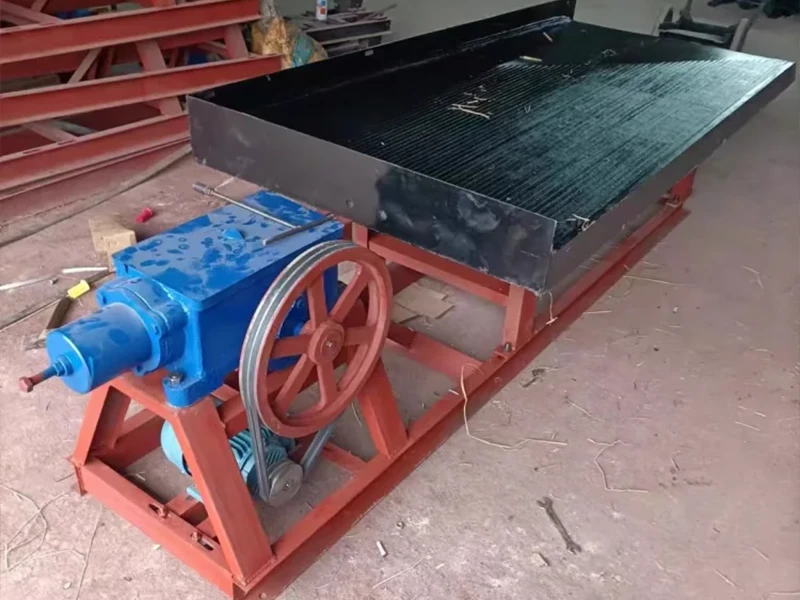
A gold mining shaking table—often referred to as a gravity concentrating table—is a specialized physical separation device designed to sort fine and micro-fine granular gold ores from heavy minerals and light gangue.
While highly celebrated for fine-grained monomer gold recovery that conventional jigging machines fail to capture, it is equally effective for processing silver, tin, tungsten, iron, and manganese.
Modern processing plants primarily utilize the 6S series gold shaking table. Decades of technical iterations have optimized the deck slopes, stroke frequencies, and water distribution configurations of this model, drastically increasing sorting accuracy and throughput compared to legacy designs. Because it features a compact structure, low operating costs, and simple installation without requiring massive infrastructure, it remains the preferred core equipment for grassroots mining sites and mobile placer gold operations worldwide.
2. Core Working Principle: The Physics of “Gold-Stone Separation”
The fundamental logic of a gold shaking table relies on density stratification combined with mechanical reciprocating motion and transverse water washing. This purely physical process guarantees high-purity gold recovery while remaining 100% compliant with global environmental protection standards.
The separation cycle occurs in three distinct, synchronized stages:
Stage 1: Density Stratification
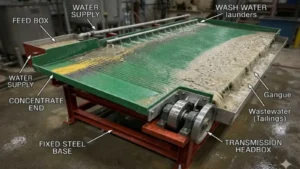
The crushed gold ore slurry is introduced uniformly via the feed box onto the inclined deck. As the horizontal water flow hits the slurry, the mineral particles become suspended and loose.
Due to the massive density gap between gold particles and typical gangue rock, instant layering occurs:
- Pure Gold Density: Approximately 19.3 g/cm3
- Gangue Minerals (Quartz/Feldspar) Density: Approximately 2.6 – 2.8 g/cm3
The ultra-heavy gold particles plunge rapidly to the bottom layer, gripping the deck surface, while the light gangue minerals float to the upper layer of the slurry.
Stage 2: Asymmetric Reciprocating Shaking
Driven by a motor-linked transmission mechanism, the table deck moves in a precise, asymmetric reciprocating motion. The forward stroke is fast and short, while the return stroke is slow and long.
This creates a powerful inertial thrust that acts directly on the heavy mineral particles settled at the bottom. These gold and heavy sand particles are driven forward longitudinally toward the concentrate discharge end. Conversely, the upper-layer light gangue particles are cushioned by the water layer and do not experience this inertial push.
Stage 3: Transverse Water Washing and Final Sorting
A uniform film of wash water flows constantly down across the inclined deck. This cross-current sweeps the upper-layer light gangue minerals down toward the lower tailings discharge side.
As the minerals travel across the deck, they fan out based on their specific gravity and size. The clean gold particles aggregate at the far concentrate end, delivering high-grade gold sand and heavy mineral concentrates while waste rocks are discarded cleanly at the bottom.
3. Structural Composition and Technical Specifications
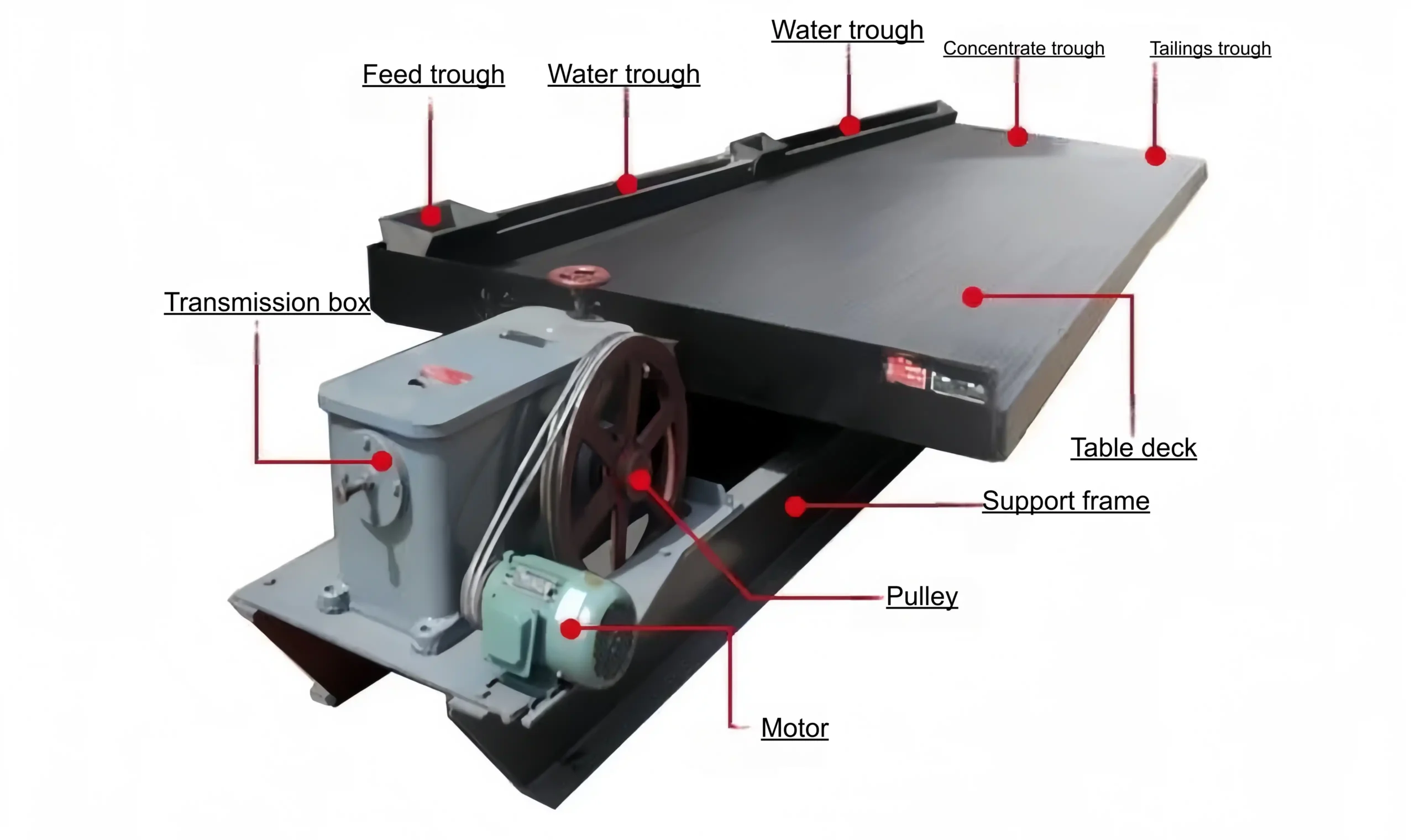
The operational stability and sorting precision of a shaking table depend heavily on the alignment of its five core structural components:
| Component | Technical Function & Material Composition |
|---|---|
| Corrugated Table Deck | Fabricated from high-grade fiberglass, seasoned wood, or wear-resistant steel plates treated with anti-corrosion coatings. The surface features uniform riffles (corrugations) that block fine gold particles from being swept away by the water cross-current. The deck inclination angle can be mechanically adjusted based on mineral density and feed size. |
| Transmission & Stroke Mechanism | Consists of an electric motor, a gear reducer, a crankshaft, and a connecting rod assembly. It dictates the stroke length (10 – 30 mm) and stroke frequency (200 – 350 strokes/min). |
| Water Supply System | Comprises water distribution tanks, pipes, and flow control valves. Provides steplessly adjustable, uniform washing water across the deck to maintain the perfect slurry-to-water ratio. |
| Ore Feeding Device | A specialized slurry feed box that evenly distributes the ore pulp in a fan shape across the deck, preventing local overloading or turbulence that disrupts mineral stratification. |
| Heavy-Duty Base Support | A rigid steel chassis designed to handle high-frequency shaking vibrations without shifting. Equipped with level-adjustment bolts to calibrate the horizontal axis perfectly during installation. |
Looking for reliable gravity separation equipment? Check out our industrial-grade 6S Gold Shaking Tables for sale with customizable configurations.
4. Primary Mining Application Scenarios
The shaking table is exceptionally versatile and is rarely limited to a single type of mining project. It is widely deployed across four major operational setups:
- Fine-Grained Gold Processing (0.02 – 2 mm): Ideal for quartz vein gold, oxidized gold ores, and fine placer deposits. It acts as a safety net for micro-gold particles that typically escape downstream from jigs and sluices.
- Middlings and Rough Concentrate Reprocessing: Rough concentrates extracted from sluice boxes, jigs, or centrifugal concentrators often retain heavy gangue minerals. Running these materials through a shaking table elevates the gold grade by multiple folds via precision cleaning.
- Sulfide & Symbiotic Ore Separation: Effectively separates free gold from accompanying heavy sulfides like pyrite and chalcopyrite, while simultaneously isolating valuable base metals like tungsten, tin, and manganese.
- Remote and Mobile Mining Operations: Compact and highly portable small-scale shaking table variants are easily mounted on mobile trucks or deployed in remote mountainous river basins with minimal infrastructure requirements.
5. Step-by-Step Installation and Commissioning Guide
Poor recovery rates on site are rarely caused by equipment failure; more often, they stem from improper leveling or uncalibrated stroke dynamics. Follow this standardized operational sequence to commission your shaking table:
- Step 1: Secure and Level the Chassis
Select a solid, reinforced concrete or heavy timber footing. Place the machine and use the level-adjustment bolts along the steel frame to ensure the longitudinal axis of the table deck is perfectly horizontal. Tighten the foundation anchor bolts firmly to eliminate any chassis drift or unwanted harmonic vibrations during high-speed operation. - Step 2: Connect and Test the Water Lines
Hook up the main water pipes to the distribution tank. Test the control valves to verify that water discharges across the deck in a smooth, continuous fluid sheet. Check for dry spots, blockages, or high-pressure leaks. - Step 3: Conduct a Mechanical Dry Run
Wire the motor and execute an empty-load test run for 10 to 15 minutes. Monitor the transmission head box for abnormal knocking sounds, excessive heat, or uneven joint play along the connecting rod. Ensure the reciprocating motion behaves smoothly. - Step 4: Live Slurry Tuning (The Operational Sweet Spot)
Introduce a controlled volume of real ore slurry. Apply the tuning hierarchy: adjust water flow first, deck angle second, and stroke metrics third. Watch how the minerals fan out on the deck.- If fine gold particles are migrating into the tailings zone, the wash water volume or the cross-slope tilt is too aggressive and must be dialed back.
- If the gold concentrate band is heavily contaminated with silica gangue, increase the wash water volume or refine the stroke frequency.
- Step 5: Lock Parameters
Once a sharp visual boundary line separates the bright gold concentrate from the dark middlings and light tailings, lock down the deck inclination adjusters and initiate full-scale production.
6. Operational Protocols and Preventative Maintenance
6.1 Standard Operating Procedures
- Maintain Steady Feeding: Slurry volume and pulp density must remain constant. Sudden spikes or drops disrupt the thin-film fluid dynamics on the deck, causing mineral stratification to collapse and forcing gold into the tailing lines.
- Real-Time Band Monitoring: Operators must constantly inspect the concentrate discharge line. If the feed particle size shifts unexpectedly, real-time adjustments must be made to the wash water valves to protect recovery margins.
6.2 Maintenance Checklist
- Post-Shift Flush: At the end of every operating shift, run clean water through the system to wash out all trapped slurry, grit, and sticky clays from the deck corrugations. This prevents dried ore from hardening inside the riffles and ruining the next day’s sorting performance.
- Crankshaft Lubrication: The eccentric transmission head motion generates immense friction. Check oil levels in the main headbox daily and grease the connecting rods to avoid catastrophic mechanical wear.
- Riffle Inspection: Over time, heavy abrasive sands will dull and round out the sharp edges of the deck corrugations. Replace or re-coat worn decks immediately; flat or worn riffles cannot trap fine gold particles.
6.3 Safety Redlines
- Lockout/Tagout (LOTO): Never perform mechanical adjustments, parameter modifications, or deck cleaning while the machine is running. Always cut the primary power supply first.
- Guards In Place: The drive belt and reciprocating connecting rods must be shielded by protective covers at all times. Keep hands entirely clear of moving components during operation.
- Waterproof Grounding: Because gold shaking tables operate in wet, humid environments, all electric motors and control enclosures must feature proper grounding and moisture insulation to eliminate electrical leakage risks.
7. Strategic Advantages of Shaking Tables in Gold Processing
- Zero Environmental Liability: Operating entirely via physical gravity principles, it bypasses the need for toxic chemicals like cyanide or mercury. This completely eliminates tailing pond chemical hazards and reduces local environmental assessment hurdles.
- Superior Return on Investment (ROI): Boasting low initial capital costs, minimal power consumption, and zero chemical overhead, it provides an exceptional gold enrichment ratio that translates directly into immediate operational profitability.
- Low Operational Barrier to Entry: The mechanical workflow is straightforward and highly automated. Operators do not require an advanced degree in metallurgy; local teams can master fine-tuning and operation after a few basic training sessions.
- Excellent Process Resilience: It handles fluctuations in ore mineralogy, clay variations, and grain distribution gracefully via simple, on-the-fly manual screw adjustments.
8. Conclusion
The gold mining shaking table remains an industry-standard benchmark for high-efficiency, green gravity separation. Its reliance on basic physical separation mechanics, matched by steady operational delivery and nominal running costs, makes it an unmatched asset for extracting value from fine-grained gold ores. By mastering systematic installation, precise parameter tuning, and rigorous daily maintenance, mining operators can successfully maximize their gold recovery yields and unlock the full economic potential of their mineral reserves.
Explore Our Equipment: Browse our full catalog of heavy-duty Gold Shaking Tables and request a free quote today!
Message us for more information
Hot News
-
08/09/2026

10 Critical Vetting & Shipping Factors When Importing Heavy Mining Equipment from China
-
07/06/2026
Why Cheap Mining Equipment Costs You More in High-Yield Gold Mines
-
06/09/2026
Comprehensive Guide: What Is Coltan and How to Process It Efficiently?
-
05/25/2026
How to Optimize Gold Shaking Tables for Max Recovery
-
05/23/2026
The Ultimate Guide to Choosing the Right Sand Making Machine: VSI, Impact, Box, or Hydraulic Open-Box Crusher?